During Clerkenwell Design Week 2026, Damian Mears & Noel Brewster sat on the Sexy Meet Sofa to discuss The Next Evolution of Workplace Design: Designing for Decisions and this is how it went..
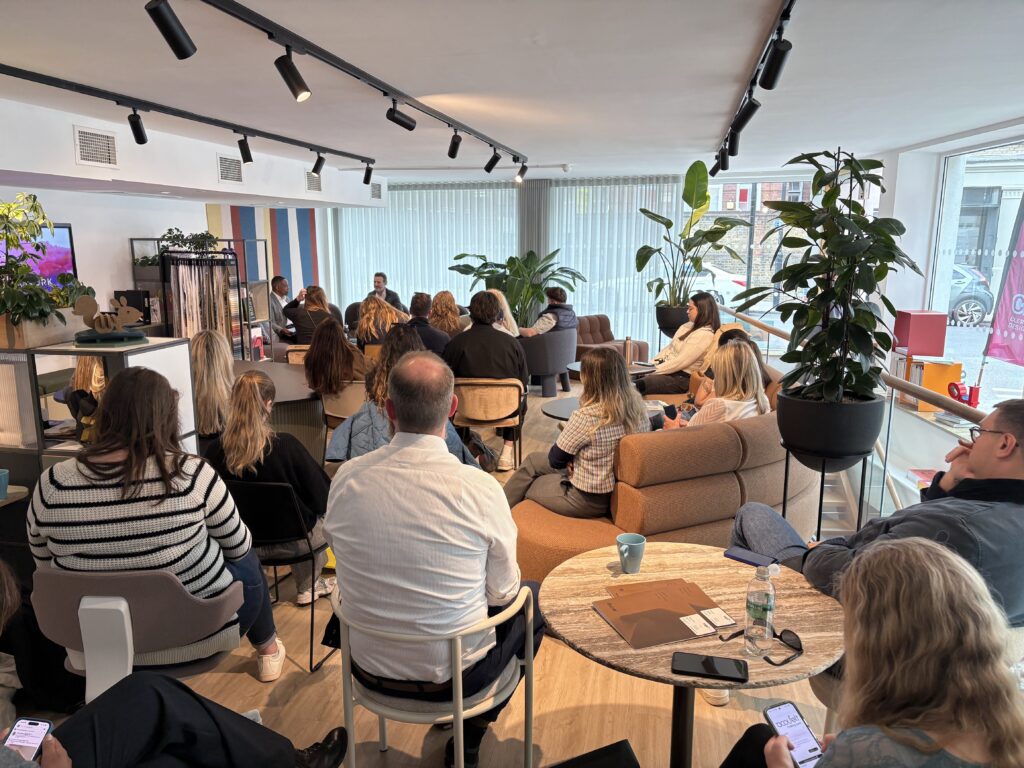
Workplace design has never been more complex — or more critical. As organisations wrestle with hybrid work, cultural fragmentation, and data overload, the real challenge isn’t choosing the right furniture or floorplan; it’s making the right decisions. The Next Evolution of Workplace Design: Designing for Decisions explores how decision intelligence is reshaping the way we plan, evaluate, and optimise workplaces. Moving beyond Activity‑Based and Experience‑Based models, this session reveals how designers, strategists, and leaders can use integrated data, behavioural insight, and scenario modelling to create spaces that truly work. Expect sharp insights, practical frameworks, and real case studies that show how better decisions lead to better workplaces.
1. The Death of the Template: Why You Can’t Copy-Paste a Strategy
One of the sharpest points Damien made during the interview was how frequently organisations try to buy a pre-packaged “trend”. He pointed out a project he managed for Mercer where the client explicitly asked for a cool, innovative pilot space based on a highly successful model used by Macquarie Bank in Australia.
On paper, the design had everything: multiple work settings, gorgeous aesthetics, and high-end collaborative furniture. On Day 1, it looked like a magazine cover.
The problem? Nobody used it. The workplace strategy was picked up in one country and dropped into a completely different corporate culture in London without any adaptation.
Damien’s Hint: Open-plan and Activity-Based Working (ABW) failed for many businesses because they were driven purely by financial constraints, trying to squeeze maximum density out of a floorplate, rather than acknowledging how human behaviour changes depending on geography, culture, and industry. A strategy that works for a tech startup in Shoreditch will completely bomb in a traditional banking firm in the Midlands if the cultural transition isn’t managed.
2. Stop Asking “What Do You Want?” (The Art of Brief Gathering)
Both Noel and Damien agreed that traditional client questionnaires are fundamentally broken. When a business decides to move or redesign, the knee-jerk reaction from HR or procurement is to issue a generic questionnaire that asks employees what they want. This results in a massive wishlist of personal preferences rather than what serves the business.
Damien credits his early mentor, Adam Burt Jones, with teaching him the true art of brief gathering: You must stop asking what they want, and relentlessly ask why they need it.
Noel and Damien’s Masterclass Questions for Clients:
“What do you want to keep?” Designers love to walk in and promise a complete clean slate. But Damien notes that asking what is already working well prevents you from destroying the psychological “home” and micro-cultures that employees value.
“What type of collaboration are you actually doing?” Management often screams that they need “more breakout spaces for collaboration.” But a skilled consultant drills into the modes: Is it a 10-minute ad-hoc catch-up? A structured, all-day quarterly workshop? A confidential brainstorming session? Each one requires a completely different furniture system, acoustic privacy level, and layout.
“What is the gap of change?” If you are moving a business from a traditional, hierarchical cellular layout to a completely flat, agile environment, that behaviour modification does not happen overnight. Damien highlighted a change program at Credit Suisse that required three full years of careful change management and post-occupancy refreshing just to make the new space stick.
3. The Future: Decision-Based Working, Data Cross-Pollination, and AI
Noel steered the chat toward where the industry is heading next, touching on a shift toward “decision-based working.” Since the pandemic, employees are no longer tied to desks by physical cables; mobility is total. People choose where to work based on the specific outcome they need to achieve that day, —whether that’s focus at home or intense collaboration in the office.
To build spaces that survive this rapid evolution, Damien dropped a massive tip on how to handle project data:
The Strategist’s Tip: “A great workplace strategy might only be a three-page executive summary, but it should be backed by 120 pages of cross-pollinated data.” You cannot rely on a single utilisation study or a single set of interviews. You must lay out the observational data, behaviour mapping, employee sentiment, and executive goals, and look at it all on the floor together toand find the common story they are telling.
Furthermore, Damien emphasised that workplace strategists must now look at AI not just as a tool to design a room, but as a mechanism that alters headcount, accelerates decision-making, and completely changes the physical footprint a company needs.
The Sagal Wrap-Up
As Noel beautifully summarised at the end of the panel, furniture can easily last forever, but the strategy of how humans use that furniture changes constantly. If you are treating your upcoming office refurbishment as a simple procurement exercise, buying chairs off a page to hit a head-count number, you are setting yourself up for an incredibly expensive mismatch.
Stop Guessing!
Let’s stop guessing. Let’s look at the actual data, map out your corporate culture, and design a space your teams will genuinely love to use.
Want to see how we apply this date-first thinking to real florplans?