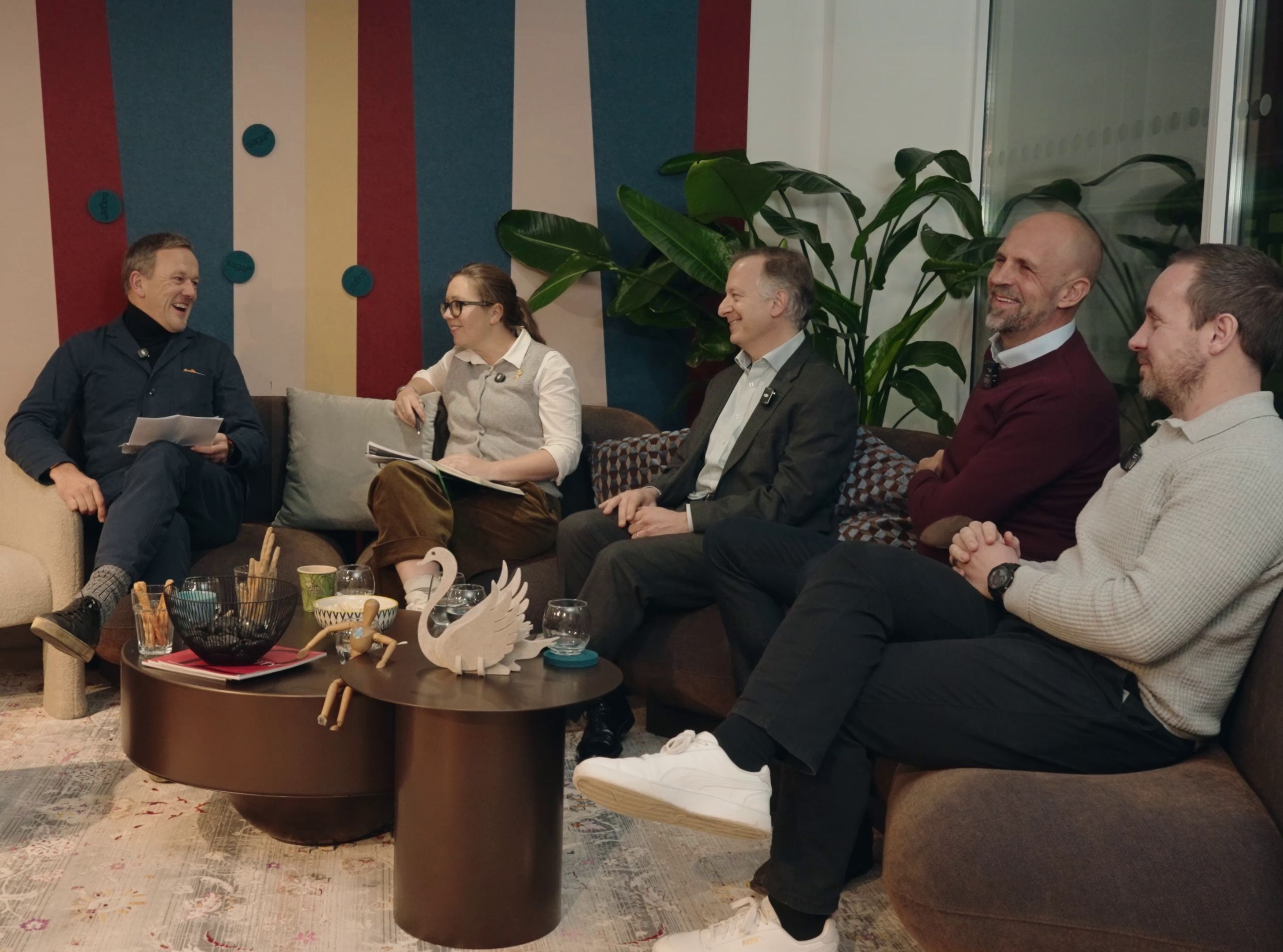
At Sagal Group, we’re passionate about creating magnetic workplaces — environments where people genuinely love where they work. And that starts with the journey to get there, which is why we brought together this panel to tackle one of the property industry’s most urgent debates: how do we get active travel right?
If you’re interested in creating a #LoveWhereYouWork environment for your team, get in touch — we’d love to help.
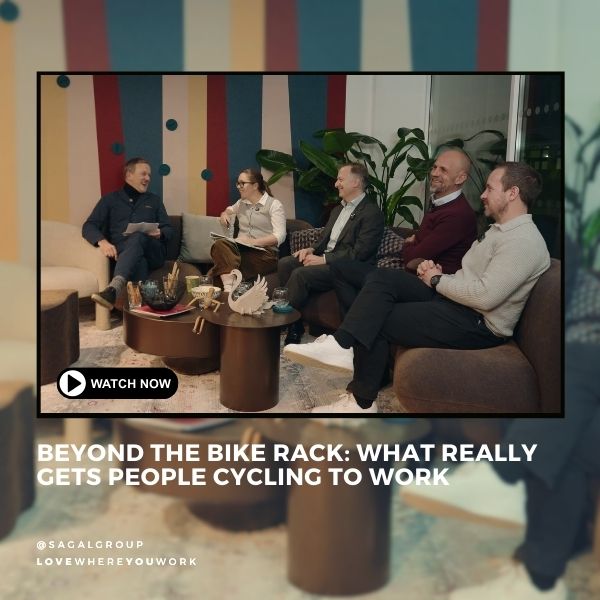
On a February evening, we brought together four brilliant minds to answer a question that’s dividing the property industry: are we building all the wrong things in the name of active travel? The conversation was frank, funny, and full of hard-won insight. Here’s what happened.
Our host David Taylor – co-founder of Velocity Magazine, a publication dedicated to “people, property and bikes” was joined by Samantha McClary, CEO of the British Council for Offices (BCO); Basil Demeroutis, Managing Partner of FORE Partnership; Justin Sires, Founder & CEO of Five at Heart; and Sam Turney, Head of Business Development at 3-Space (and former CyclingUK). The format was relaxed — a series of mini-interviews followed by an open floor discussion — and the conversation rarely stayed polite for long.
🚲 “Volume Is Definitely Not the Answer”
The evening opened with a question to Samantha about what BCO’s 4,200 members are really saying about cycling facilities. The answer was surprisingly blunt.
“There is a big feeling at the moment that they are being forced to overdeliver,” she said. “The space is underutilised, and policy isn’t thinking about the unintended consequences — like digging out basements and unlocking thousands of tons of embodied carbon trying to encourage sustainable travel. There’s frustration about the lack of understanding about how the world is operating today.”
“Volume is definitely not the answer. Quality amenities, a really good mix of things — that’s what matters.” — Justin Sires
Justin, who has spent eight years providing physical bike parking infrastructure in landmark buildings, had been making the same argument in a Westminster planning session just days before. “We’re only getting 30% utilisation of our facilities,” he said. “So why am I going to invest in amenity that’s not going to be used? That’s not sustainable from a carbon perspective, and it’s not sustainable from a return on investment perspective.”
He even acknowledged the irony head-on: “Planners look at me inquisitively and say, ‘But you sell bike parking.’ But we’re passionate about delivering sustainable outcomes. We want to survive as a business — but we also want a sustainable industry, and that doesn’t come from an arms race of numbers.”
✨ Remove the Friction — All of It
If there was one phrase that echoed through the whole evening, it was “points of friction.” Basil put it best:
“Is the barrier that we don’t have enough cycle racks? The answer is no. So let’s put that aside. What are the actual barriers?” — Basil Demeroutis
He painted a vivid picture of the subtle deterrents that kill cycling intent before it ever turns into habit: “It’s when it’s wet outside, or there’s nowhere to put your bike at the station, or I have to go past the waste bins at the back to get to the bike racks, or it’s a labyrinth to get out and I just feel unwelcome. These are subtle little bits of friction — and we’ve got to remove them.”
FORE Partnership have put this thinking into practice. At CAD Works in Glasgow they installed Scotland’s first cycle-in ramp — glass-walled, visible from reception and, by Basil’s own description, slightly thrilling: “You zoom down it, you have this moment of fear as you round the corner — it’s kind of fun.” At TBC London, the facilities sit right next to the main entrance, with drying rooms, bike wash stands, cool-down zones, and Brompton lockers in reception — because if a visiting cyclist has to haul their bike through the lobby, argue with security, and take it to the 12th floor, the battle is already lost.
On that last point, Basil shared that he was once frog-marched out of 100 Liverpool Street by two security officers for arriving on his Brompton — at a climate event, no less. You really can’t make it up.
🤝 The Software Is as Important as the Hardware
Sam Turney brought a perspective shaped by years accrediting organisations as cycle-friendly employers at Cycling UK. The accreditation scheme, overseen by the European Cyclists’ Federation, covers six categories. Physical facilities is only one of them.
“The behaviour change stuff — route planning, communication, getting an external bike doctor in, buddy systems — has a far bigger effect on the number of people cycling to a workplace than whether you’ve got a thousand bike racks and how nice they are,” Sam said.
“Most of the population have probably got an old mountain bike in the shed. For fifty quid you can probably get it roadworthy. It’s the encouragement and the nudge to actually use it.” — Sam Turney
Basil echoed this with programmes from FORE’s own buildings: charity cycle rides at Number One Poultry, and a buddy system in Glasgow specifically designed to help women feel safer and more confident cycling to work. “If the outcome we want is more people on bikes, we know women don’t cycle as much as men — so you buddy someone up with a more experienced cyclist. Again, it’s this software that has to go along with the obsession about numbers of lockers and double stackers.”
Justin added a striking data point from Australian research: in buildings with end-of-trip facilities, cyclists are actually a minority of users. “It’s your runners, your gym-goers, your before-niners and after-fivers. So the change room isn’t just an end-of-trip facility — it’s a wellness offering. And if you can get cross-usage throughout the day, you’re getting the best bang for your buck.”
🗺️ The Problem Is Beyond the Red Line
The mood shifted when the conversation turned to the world outside the building. Because all the best cycle facilities count for nothing if the journey to reach them is dangerous — or simply doesn’t exist.
Samantha was clear: BCO’s research shows the top two reasons people don’t cycle are distance and safety. Neither is a problem any building can solve alone.
“There are boroughs in London where we will not invest. RBKC being one of them — until recently, it was the only borough in London without a single metre of protected cycle highway. It’s a hostile environment.” — Basil Demeroutis
Basil described a proposed new cycle highway along Bayswater Road currently facing fierce opposition from residents’ associations with just 30 or 50 members — but enough political influence to stall progress. “If you’re a ward councillor elected by 1,200 votes to 800, and 500 of your voters are against the cycle lane, who are you going to listen to?”
The conclusion was clear: this is a system problem that requires system thinking. Individual buildings can do a great deal, but the urban infrastructure around them has to follow.
Justin offered two examples of what courage looks like in practice. At Sugar House Island, developer Vastint stepped back from the full cycle parking mandate and instead created a social bike hub serving not just tenants but the whole local community — complete with a café and a genuine neighbourhood feel. At 22 Bishopsgate, a basement level sitting at 30% utilisation (intended for lockers, bike racks and showers) is now being repurposed as a pickleball court. “If it had been fitted out with lockers and showers, Axa would have said, ‘We’ve got a sunk cost.’ Instead, they’ve got a canvas to put in amenity that actually works for the building.”
🌱 Reasons to Be Cheerful
Just as the mood threatened to tip into gloom, the panel pulled it back. David asked whether anyone in the room was unconvinced by what they’d heard. Not a hand went up — a room full of the converted. Which raised its own question: how do you reach the people who aren’t already here?
“We need organisations like the BCO who speak loud,” said Basil. “We’re one small landlord. But you speak for 4,200 people. We need the right voices reaching government.”
Sam pointed out that London’s cycling numbers have grown exponentially over the past 25 to 30 years — and the reason is clear: cycle superhighways work. The infrastructure, when done properly, changes behaviour. An audience member noted that the Embankment counter was clocking 5,000 cyclists by noon on a rainy Tuesday in January. Pretty punchy.
“The industry understands its customer. It doesn’t need to be told what to do. What the BCO can do is act as a convening body — to talk about the world beyond the red line.” — Samantha McClary
Samantha closed with a thought that felt both humble and galvanising: the property industry is already doing a great job of creating great spaces — it doesn’t need more guidance on that front. What it needs is collective advocacy for the infrastructure that lies beyond the building’s boundary. That’s where the BCO, events like this one, and voices like David’s come in.
The evening wound down to open questions about Oxford Street pedestrianisation, the merits of infrared saunas (apparently hitting near-100% utilisation, unlike the lockers they’d replace), mandatory cycling proficiency tests, and the respective dangers of lycra-clad commuters on the Embankment. There was rum. There were strong opinions. There was, above all, a shared belief that more people on bikes is a good thing — and that getting there requires all of us, working together.
Thank you again to our panellists
Samantha McClary, CEO, British Council for Offices · Basil Demeroutis, Managing Partner, FORE Partnership · Justin Sires, Founder & CEO, Five at Heart · Sam Turney, Head of Business Development, 3-space
Want to join us for our next event? Find out more at events@sagalgroup.co.uk — we’d love to have you in the room.
#LoveWhereYouWork #LoveWhereYouRide